
Sovereign wealth funds occupy a unique position in the global financial landscape. They are simultaneously long-horizon investors, national stewards, and increasingly sophisticated allocators spanning public equities, private markets, infrastructure, real assets, and now digital assets. That breadth of mandate is their strength, and the source of some of the most complex data management challenges in institutional finance.
For decades, SWFs could manage data complexity through headcount and siloed systems. Today, that model is under strain. Regulatory scrutiny has intensified across every jurisdiction. The proliferation of data sources from traditional market data to ESG signals, alternative data, and real-time analytics has accelerated far beyond the capacity of legacy infrastructure to absorb. And the shift toward active management, driven by geopolitical volatility and concerns about index concentration, means that the quality and timeliness of data is directly influencing returns.
This piece examines the specific data challenges facing sovereign wealth funds in 2025 and explores the structural approaches that leading asset owners are using to address them.
The Landscape: Why data management has become a strategic priority for sovereign funds
The scale and diversity of sovereign wealth mandates create data challenges that are qualitatively different from those facing typical asset managers. A sovereign fund managing a multi-trillion-dollar portfolio across dozens of external managers, direct investments, co-investments, and fixed income allocations is not simply dealing with more data it is dealing with fundamentally different data architecture problems.
74% of sovereign wealth funds now consider climate and ESG risks in their decision-making creating significant new data sourcing and normalization demands across portfolios.
Source: IFSWF / Invesco Global Sovereign Asset Management Study
The challenge has several distinct dimensions that compound one another:
Multi-manager opacity – Capital allocated to external managers creates look-through complexity. Understanding true exposure across a layered fund hierarchy in near real-time requires data infrastructure that most legacy systems were not designed to support.
Cross-border regulatory pressure – SWFs operate across dozens of jurisdictions, each with its own reporting standards, benchmark regulations, and data localization requirements. Compliance demands are growing faster than internal teams can absorb them.
Benchmark and index proliferation – Diversification into thematic, factor, and ESG indices has multiplied the number of benchmarks that must be sourced, validated, and mapped often from multiple competing data providers with inconsistent coverage.
Legacy infrastructure debt – Many sovereign funds built their data infrastructure during an era of simpler mandates. Replacing or integrating those systems while continuing to operate at scale is a major undertaking with significant operational risk.
The result is a pattern that Rimes has observed across institutional investors globally: data is decentralized, validation is inconsistent, and internal teams spend significant capacity on data plumbing rather than investment decision-making.
The Standard: What a modern data operating model actually looks like
The funds navigating this environment most effectively share a common architectural philosophy: they treat data management as a strategic capability, not a back-office function. That shift has practical implications for how they source, validate, distribute, and act on investment data.
Three structural capabilities tend to differentiate leading sovereign investors in this regard:
A unified data foundation: Single source of truth, across asset classes and managers
The most significant operational risk in sovereign fund data management is reconciliation failure different teams working from different versions of the same data. Leading funds are moving toward a centralized “gold copy” of investment data, validated and maintained by a single authoritative process that serves every downstream workflow from risk to compliance to performance attribution.
This is not simply a question of technology. It requires disciplined data governance, clear ownership of data quality, and the operational capacity to maintain that standard across a continuously expanding universe of data sources and asset classes.
Full fund look-through: Visibility through complex ownership hierarchies
For sovereign funds that allocate across dozens of external managers, understanding true portfolio exposure requires the ability to look through fund-of-fund structures to underlying holdings. This is essential for accurate risk management, ESG reporting, and rebalancing and it is genuinely difficult to achieve without purpose-built technology.
The investment book of record (IBOR) concept is central here: a fund-level view that captures all positions, exposures, and valuations in a consistent, timely, and trusted format. Sovereign funds that have implemented robust IBOR capabilities report significantly improved confidence in their rebalancing and allocation decisions.
Outsourced operational burden: Freeing investment teams to focus on decisions, not data
One of the most consequential shifts in institutional data management over the past decade has been the normalization of outsourcing data operations to specialist providers. The economics are compelling: internal data teams at sovereign funds typically carry the full cost of sourcing, licensing, validating, and distributing data from hundreds of providers a function that specialist firms can perform at greater scale, with better tooling, and at lower cost per unit.
Critically, this is not about reducing capability. It is about concentrating scarce internal expertise on areas where sovereign funds genuinely have competitive advantage investment judgement, manager selection, and strategic allocation rather than on data engineering that is not a source of alpha.
The Rimes Approach: From data complexity to investment clarity
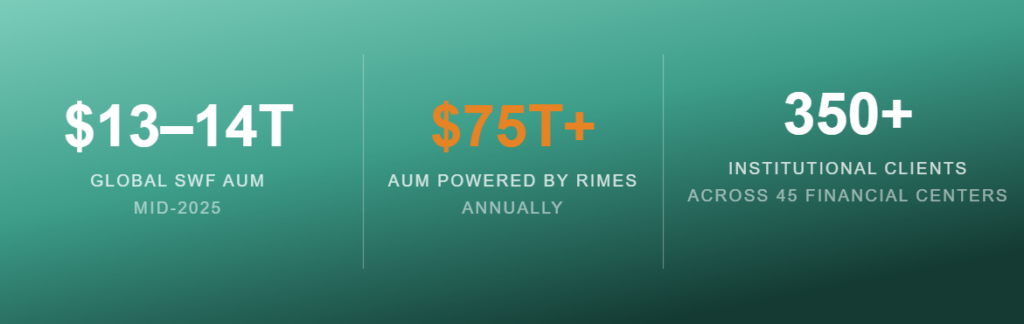
Rimes was built to address exactly the kinds of data challenges that sovereign wealth funds face. With over 350 institutional clients across 45 financial centers including some of the world’s largest public pension funds, endowments, and sovereign investors, Rimes has developed a body of operational knowledge and technology capability that is specifically calibrated to the complexity of multi-asset, multi-manager, cross-border mandates.
Its proposition rests on four interconnected capabilities:
Enterprise benchmark and index management
Sovereign funds use benchmarks for everything from performance measurement to mandate compliance to ESG reporting. But benchmark data management sourcing, validating, normalizing, and distributing index data from multiple providers is operationally intensive and prone to error when handled through fragmented internal processes. Rimes provides a managed service for the full benchmark lifecycle, covering more than 100,000 data feeds daily from over 1,800 data partners, with SLA-backed quality guarantees and 24/7 operational coverage. For funds moving into thematic or ESG benchmarks, this breadth of coverage is particularly valuable.
The Investment Intelligence Platform
Matrix is Rimes’ cloud-native Investment Intelligence Platform designed to address the look-through problem directly, enabling funds to drill through complex ownership hierarchy’s external manager allocations, fund-of-fund structures, direct holdings to surface underlying exposures in a consistent, validated format. The platform supports strategic asset allocation, portfolio rebalancing, NAV oversight, and performance reporting within a single environment, reducing the reconciliation burden that typically arises when these functions are handled by separate systems.
The rebalancing capability is particularly relevant for sovereign funds managing large, diversified portfolios: Matrix automates cash allocation and rebalancing according to policy and mandate requirements, reducing both the operational burden and the risk of mandate drift.
Managed data operations
For sovereign funds carrying the cost of large internal data teams, Rimes’ outsourced data operations model offers a structural alternative. Rimes acts as an extension of the client’s data function sourcing, validating, and distributing investment data according to client-specific policies and best practices while the internal team focuses on higher-value activities. The service includes access to former CDOs and asset class specialists who provide advisory support on data governance and management strategy, not just operational delivery.
ESG and alternative data integration
The ESG data landscape is still maturing coverage is inconsistent across providers, methodologies vary significantly, and integrating ESG signals into investment workflows requires careful normalization. Rimes has invested in specific ESG data management capabilities, providing a managed service for ESG data sourcing and integration that helps funds meet their sustainability reporting requirements without building the underlying infrastructure internally.
Market Context: How Rimes fits within the broader data services landscape
The investment data management market includes a range of providers, from global custodians offering bundled data services to pure-play technology vendors, specialist analytics firms, and full-service managed data providers. Understanding where Rimes sits in that landscape and what distinguishes its approach is useful context for sovereign funds evaluating their options.
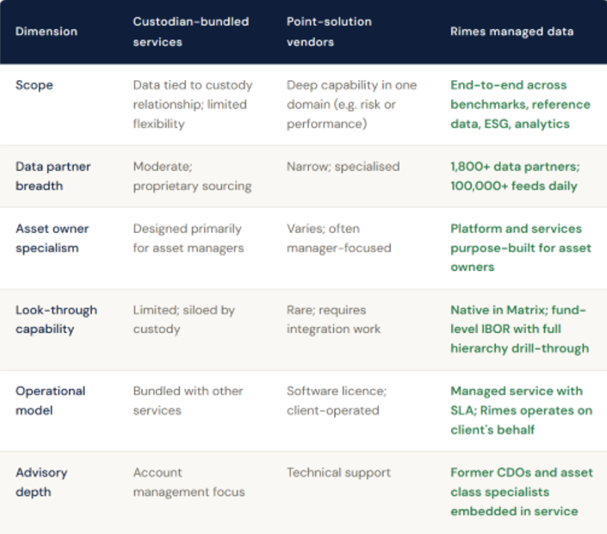
The key differentiator for sovereign funds is the combination of managed service delivery where Rimes bears operational responsibility for data quality and availability with genuine asset owner specialism. Many data platforms are designed primarily for asset managers, where the data flows and workflows are materially different. The specific look-through, rebalancing, and multi-manager complexity that defines sovereign fund operations requires a different class of solutions.
Rimes’ position as a strategic partner to State Street Alpha, and its track record with some of the world’s largest asset owners, reflects the degree to which its capabilities have been tested at institutional scale not built for a hypothetical enterprise use case.
Practical Considerations: What sovereign funds should evaluate when modernizing data infrastructure
Decisions about data infrastructure are long-term commitments with significant switching costs. For sovereign wealth funds, the evaluation of any data management partnership should address several dimensions that go beyond feature comparison:
Operational resilience – Mission-critical investment data cannot tolerate downtime or data quality failures. Sovereign funds should assess provider SLAs carefully, examine operational track records, and understand how providers handle restatements and corrections which are a normal feature of index and benchmark data but can cause significant downstream problems if not managed proactively.
Scalability of coverage – Sovereign mandates evolve. A fund expanding into private credit, digital assets, or new geographic markets will need data infrastructure that can absorb new asset classes and data sources without requiring a rebuild of the underlying architecture. Provider breadth in terms of data partnerships, asset class coverage, and geographic reach is a meaningful forward-looking consideration.
Integration with existing systems – Few sovereign funds are starting with a clean slate. The ability to integrate new data capabilities with existing risk systems, custodian feeds, and reporting workflows through flexible APIs and data distribution models significantly affects the practical value of any new platform or service.
Governance and transparency – For sovereign investors with public accountability requirements, the auditability of investment data who sourced it, when it was validated, what transformations were applied is not just operationally useful but potentially a governance requirement. Understanding how providers document their data lineage and validation processes is increasingly important.
The competitive advantage of information
Sovereign wealth funds have always competed on the quality of their investment judgement. Increasingly, that judgement depends on the quality of the data and analytics infrastructure behind it. The funds that move earliest to establish a modern, scalable, and trusted data operating model will be better positioned to act on opportunities, manage risks, and meet the growing expectations of governments, beneficiaries, and counterparties.
The data challenge is not primarily a technology problem it is an operational and strategic one. Solving it well requires expertise, scale, and a genuine commitment to the specific complexity of multi-asset, multi-manager, long-horizon investing. That is the work Rimes was built to do – visit our dedicated sovereign wealth resource page to learn more and book a demo.